
Australia is running an anti-dumping investigation into Chinese titanium dioxide (TiO₂), case number 699, covering all of 2025. The complainant is Tronox — Australia’s only TiO₂ maker, based in Western Australia.
On 3 and 4 August 2026, Tronox filed two back-to-back submissions. The bottom line of both is simple: China’s domestic TiO₂ prices should not count, and a more expensive way of calculating “normal value” should be used instead — which would produce a much higher dumping margin.
Why does Tronox say China’s prices “don’t count”? It leans on a legal concept called a Particular Market Situation (PMS). Think of it this way: if China’s costs for titanium ore, electricity and sulphuric acid are pushed artificially low by government policy, then the low prices Chinese producers charge at home can’t be used as the “fair price” benchmark. Tronox lists a chain of reasons — ilmenite’s export tax rebate was withdrawn, state firms get subsidies, park-supplied power and acid come at “internal” prices, and iron-ore subsidies spill over into cheap titanium feedstock. By its math, those three inputs alone make up about 71% of production cost.
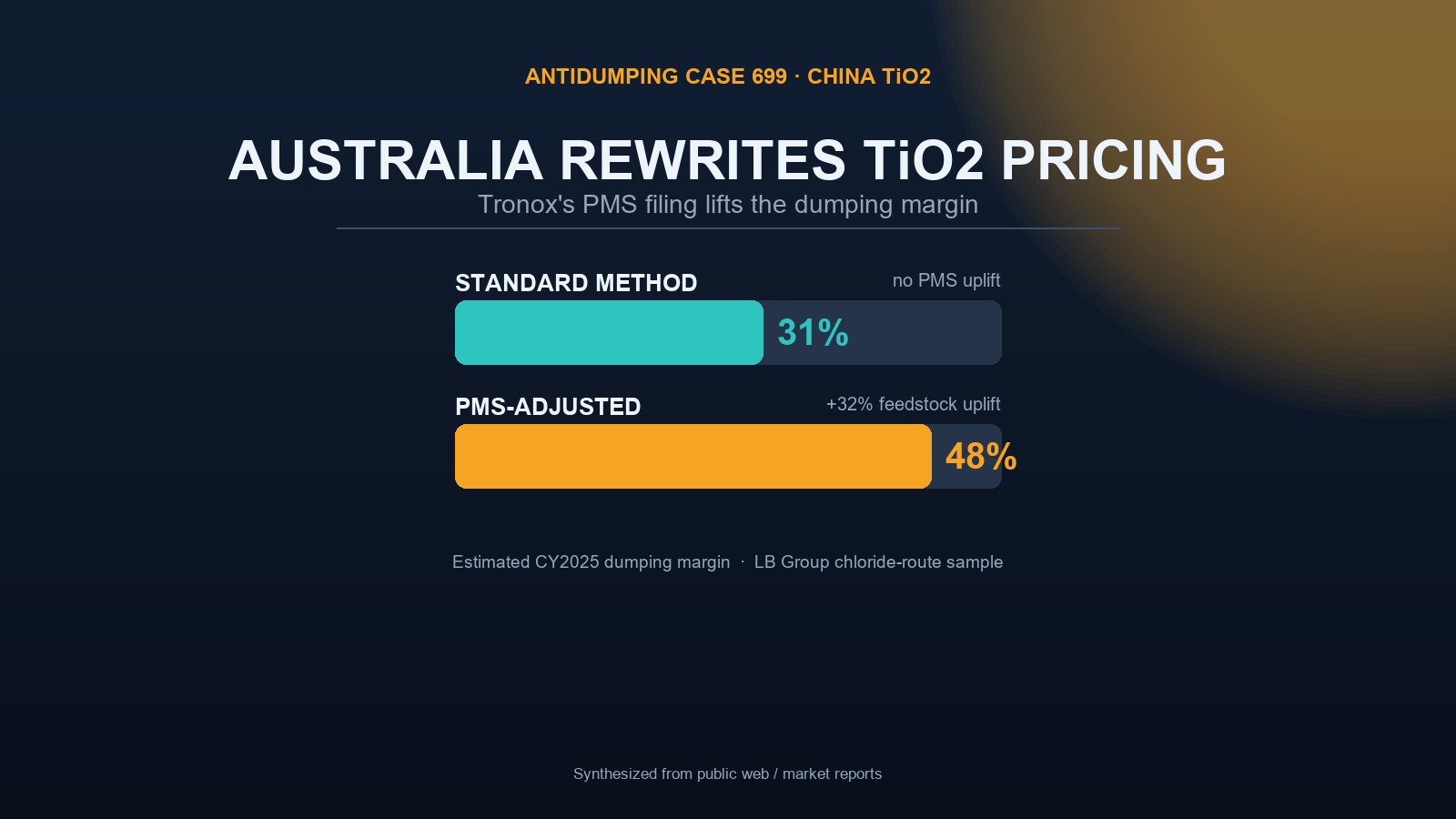
Using LB Group’s chloride-route plant as a sample, Tronox adds a 32% uplift to feedstock cost and arrives at a CY2025 dumping margin of 48% — versus 31% with no uplift. It also says that just the choice of how to value ferrous sulphate can swing TiO₂ cash cost by roughly US$770 per tonne (US$420–1,295/t).
The second filing (4 August) is a direct rebuttal to LB Group, which had submitted a defence on 6 July arguing no PMS exists. Tronox hits back point by point — most sharply, that LB never actually denied the key facts: Party-overlapping management, fourteen pages of disclosed government subsidies in its annual report, the Anning acquisition that locked in captive ore supply, and titanium’s designation as a state strategic mineral. Tronox also catches a calculation slip: LB converted Panzhihua ilmenite “below RMB1,800” to about US$265, but at 2025’s ~7.2 exchange rate, RMB1,800 is closer to US$250.
Why it matters: if Australia adopts the PMS route and rebuilds the price benchmark, the anti-dumping duty on Chinese TiO₂ would rise materially. And this is no isolated move — the EU, Brazil and Saudi Arabia already have duties on Chinese TiO₂ in force, and the UK opened its own investigation in March 2026. The global TiO₂ map is being redrawn behind one tariff wall after another.
The next thing to watch: Australia’s Anti-Dumping Commission is expected to publish its Statement of Essential Facts (SEF) in August 2026, with a 20-day comment window. That document will reveal how much of Tronox’s “particular market situation” argument actually sticks.
Sources: Australian Anti-Dumping Commission Electronic Public Record (Investigation No. 699), public submissions #19 (3 Aug 2026) and #20 (4 Aug 2026). Compiled by Randall Zheng