

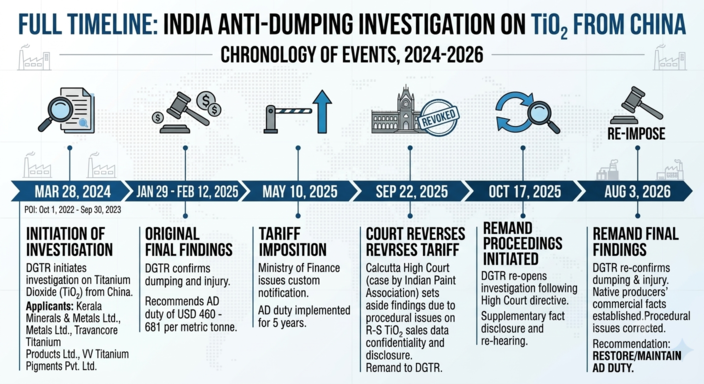
August 4, 2026 — India’s Directorate General of Trade Remedies (DGTR), under the Ministry of Commerce and Industry, officially issued its Remand Final Findings on August 3, 2026, regarding the anti-dumping case against Titanium Dioxide (TiO2) originating from or imported from China. Following re-examination and legal procedural review, the DGTR decided to maintain its original investigation conclusions and officially recommended to the Indian Ministry of Finance to continue imposing anti-dumping duties on Chinese TiO2 products.
I. Case Background and Reasons for Kolkata High Court’s Quashing of the Ruling
The initiation of this remand proceeding stems from a lawsuit filed by the Indian Paint Association (IPA) with the Kolkata High Court against the original anti-dumping measures. On September 22, 2025, the Kolkata High Court ruled on the lawsuit, adjudging that the previous executive order imposing anti-dumping duties on Chinese TiO2 contained procedural compliance flaws. Consequently, it quashed the order according to law and remanded the case to the DGTR for re-investigation.
According to the Kolkata High Court’s judgment, the original anti-dumping investigation had issues in the following key procedures:
- Confidential treatment of commercial sales data: The original investigation was not sufficiently standardized in affirming information confidentiality and providing non-confidential summaries regarding the commercial sales data of Rutile Titanium Dioxide via the sulfate process (R-S TiO2);
- Failure to fulfill statutory disclosure obligations: When acting under the provisions of Rule 7(2) (concerning the handling and examination of confidential information) and Rule 16 (concerning essential facts disclosure prior to a ruling) of India’s Anti-Dumping Rules, the investigating authority failed to provide comprehensive and compliant disclosure of essential facts to interested parties.
Addressing the above procedural issues, the Kolkata High Court required the DGTR to render a new ruling after correcting procedural flaws, holding new hearings, and re-examining relevant factual evidence.
II. DGTR Remand Investigation Results and Three Core Findings
After receiving the remand instruction from the High Court, the DGTR reorganized the investigation procedures, conducted a re-investigation, and provided interested parties with opportunities for new hearings. Following a comprehensive review of the case file evidence, the DGTR made the following three key legal and factual findings in its remand report:
- Commercial production and sales by domestic producers are established: The DGTR reaffirmed that evidence shows the Indian domestic TiO2 producer (TTPL) possesses relevant production technology and had, during the Period of Investigation (POI), actually commercially produced and sold Rutile-Sulfate TiO2 (R-S TiO2) to downstream customers, including domestic coating manufacturing enterprises in India.
- Sulfate process and chloride process products constitute “Like Articles” and possess interchangeability: Regarding the scope dispute of the Product Under Consideration (PUC), the DGTR determined that Rutile-Sulfate TiO2 (R-S TiO2) and Rutile-Chloride TiO2 (R-C TiO2) are interchangeable in terms of physicochemical characteristics and downstream practical applications. Both constitute “Like Articles” under the anti-dumping legal framework.
- Procedural compliance and information disclosure obligations have been fully fulfilled: Addressing the procedural defects pointed out by the Kolkata High Court, the DGTR re-examined the confidential information handling workflow during the remand process. It strictly followed the legal requirements of Rules 7(2) and 16 of the Anti-Dumping Rules to supplementally disclose essential facts to all interested parties, ensuring procedural compliance.
III. Final Determination and Conclusion
Based on the above remand investigation results, the DGTR explicitly adjudicated in its issued Remand Final Findings: to continue retaining Rutile-Sulfate TiO2 (R-S TiO2) within the scope of the Product Under Consideration (PUC), and to officially submit a recommendation to the Indian Ministry of Finance to continue imposing anti-dumping duties on Titanium Dioxide originating from or imported from China. This remand ruling fixes the procedural defects of the previous ruling quashed by the court and provides the latest investigative basis for the Indian Ministry of Finance’s subsequent implementation of tariff policies.